See prices From 116 EUR · Free cancellation available
Contents
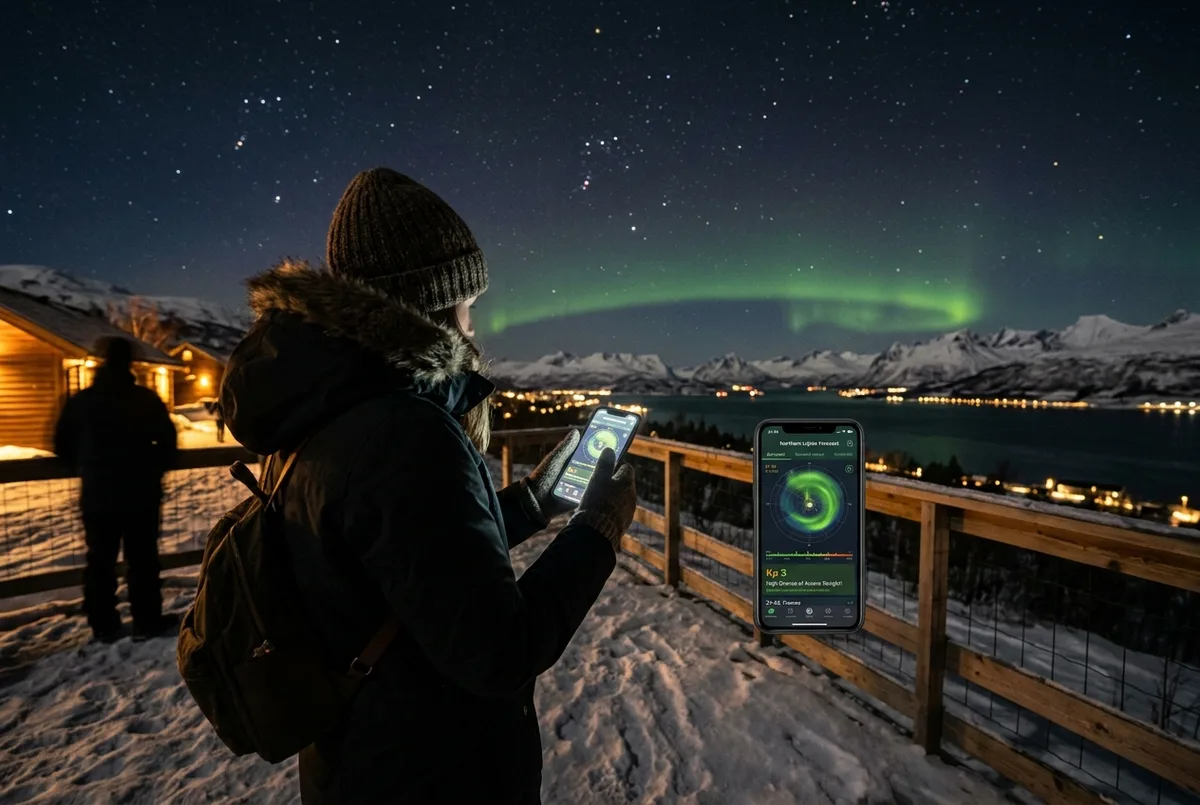
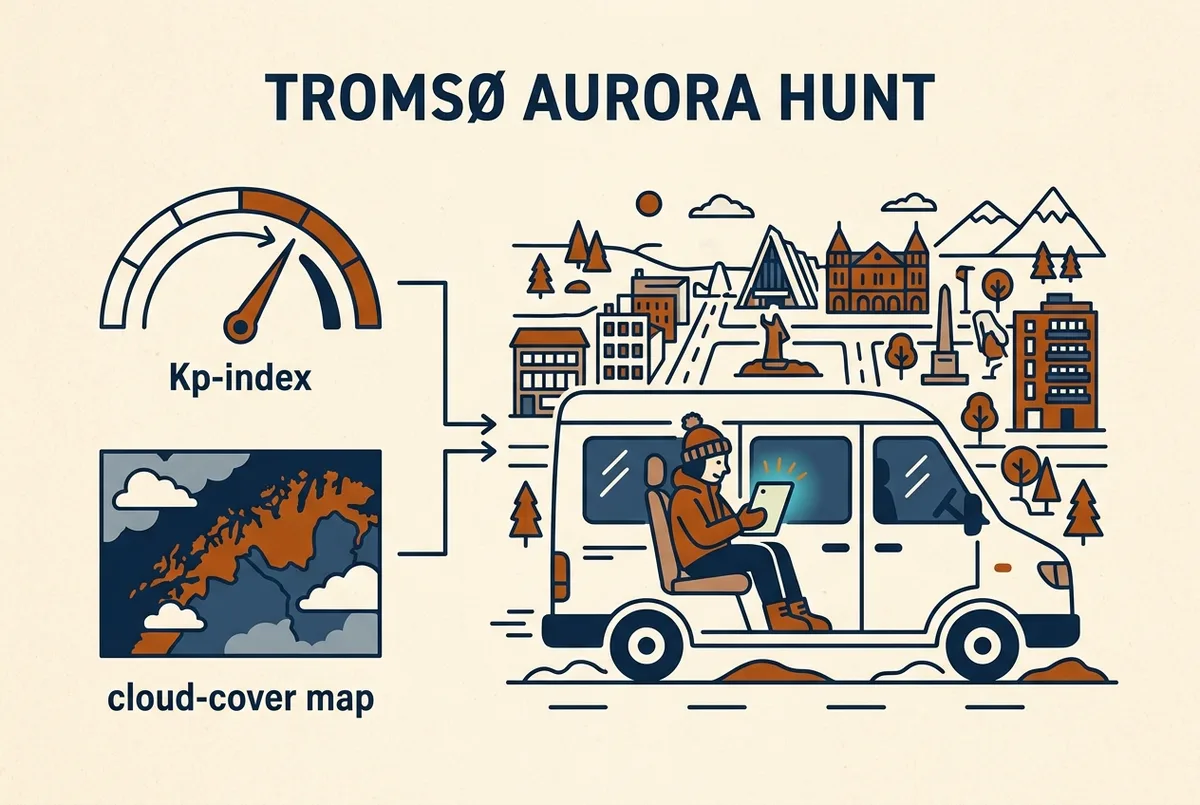
The northern lights Tromso forecast question really has two parts: how active is the sun right now, and how clear is the sky over Tromso tonight. Both matter, and checking only one is the single biggest reason people miss a display that was technically forecast. Here is what I would actually do before heading out: pull up a free Kp-index tracker and a separate cloud-cover map, cross-reference them for your exact evening, and treat any app’s “aurora chance” percentage as a rough guide rather than a guarantee, since none of them account for Tromso’s famously fast-changing coastal weather the way a guide watching live regional webcams can. This page walks through the tools I would actually trust, how far ahead any of them are worth checking, and why I would still hand the final decision to a guide rather than my own phone screen.
Which Free Apps Actually Give a Reliable Tromso Forecast?
The NOAA Space Weather Prediction Center’s 30-minute aurora forecast is the source most guides and serious aurora chasers check first, since it updates the Kp index and the visibility oval in near real time using real satellite data rather than a modeled guess days out.
I would pair that with a separate cloud-cover map for northern Norway specifically, since a high Kp reading is worthless if Tromso itself sits under a thick cloud bank that night. A few dedicated aurora apps bundle both into one screen, which is convenient, but I would still double-check the raw NOAA data before writing off a night as hopeless, since app interfaces sometimes lag the source by an hour or more.
Check prices & dates
Ready to visit?
Book your tickets in advance: popular time slots sell out.
The Kp index is a 0 to 9 scale measuring geomagnetic activity, and at Tromso’s high latitude even a modest Kp of 2 or 3 can produce a strong, overhead display, unlike destinations further south that need a Kp of 5 or higher to see anything at all.
I would not wait for a dramatic Kp 6 or 7 forecast before booking a tour. My full breakdown of the Kp index and solar activity goes deeper into why Tromso’s location makes it one of the most forgiving places in the world for a lower-activity night, which is a genuinely useful thing to know if you are watching the forecast anxiously in the days before your trip.
How Far Out Can You Actually Trust a Forecast?
Not very far. A same-night or next-day cloud and Kp forecast is genuinely useful, but anything more than about three days out is closer to a rough seasonal average than a real prediction, since both solar activity and coastal weather change too fast to model reliably that far ahead.
I would not build travel plans around a specific solar-storm forecast issued weeks in advance. What I would do instead is pick your travel dates using the broader seasonal pattern, then start checking the real short-range forecast only once you are within two or three days of an actual evening out.
Is There a Reliable Alert Service for Tromso Aurora Activity?
A few free aurora apps offer push notifications when the Kp index crosses a threshold you set, which I would treat as a genuinely useful backup rather than something to rely on exclusively, since a threshold alert says nothing about whether Tromso itself is actually clear that moment.
I would set an alert as a prompt to go check the fuller picture yourself, cloud cover included, rather than as a standalone signal to head outside. A Kp alert firing at 2am is not much use if you are not dressed and ready to move quickly, so I would only rely on one during a stretch of your trip where you are already prepared to act on short notice.
Why Does a Guide Beat Checking an App From Your Hotel Room?
Because a guide is not just reading the same forecast you are, they are actively watching a live network of regional cameras and adjusting the route through the evening as new data comes in, something no static app screen can do for you from a hotel window.
I would let a guide do this work rather than trying to replicate it yourself. The Tromsø Family-Run Aurora Minibus Tour is a good example of this in practice, since the operators follow live webcams and weather data across the region in real time and change direction mid-evening if a clearer patch of sky opens up somewhere else, which is exactly the advantage a forecast app alone cannot give you.
Should You Trust a Forecast That Predicts Zero Chance?
Mostly, yes, if it is a same-day forecast showing heavy, region-wide cloud cover, since there is genuinely nothing to see through solid cloud regardless of how active the aurora is above it, no matter what the Kp index happens to read that night.
I would still not cancel an evening out purely on a mediocre Kp forecast, though. A “low” Kp reading combined with genuinely clear sky has produced strong displays plenty of times, since Tromso’s latitude does most of the real work; the Kp number is only half the picture and I would never treat it as the deciding factor on its own.
What Time of Evening Should You Start Checking?
I would start checking the forecast from around 4pm local time on the day itself, once that afternoon’s cloud models have had time to firm up, rather than relying on a forecast pulled the night before.
Conditions genuinely shift through an evening in Tromso, which is a coastal city with famously changeable weather. A guide checking updated data right before departure, and again partway through the chase, is making decisions with far better information than anyone relying on a single forecast checked at breakfast.
Is It Worth Paying for a Premium Forecasting App?
Not really, in my view. The free NOAA data and most free aurora-tracker apps give you everything a casual traveler needs, and the real edge on any given night comes from local knowledge and live regional cameras, not from a paid subscription tier on an app.
I would spend the money on a better Tromso aurora borealis tour instead of a premium forecast app. A guide with a strong camera and webcam network, like the ones featured on this site, is doing a more sophisticated version of what a paid app promises, and doing it in real time throughout your actual evening out.
My Honest Recommendation on Checking the Forecast
I would check NOAA’s Kp forecast and a regional cloud map together, starting a few days before your trip for general planning and then again from mid-afternoon on the day itself for a real go or no-go decision. Beyond that, I would hand the job over to a guide rather than standing outside refreshing an app, since that is genuinely where the free tools stop being useful and local, real-time judgment takes over.
That is really the whole case for a guided chase over a self-planned evening: the forecast only gets you as far as “conditions look promising somewhere in the region tonight.” Turning that into an actual sighting is a live, evening-long decision that a forecast-led guide is simply better positioned to make than a traveler checking a phone screen from a fixed spot.
Frequently Asked Questions
What is the best free tool for a Tromso northern lights forecast?
I would start with NOAA’s Space Weather Prediction Center 30-minute aurora forecast, then pair it with a separate regional cloud-cover map, since neither one alone gives you the full picture.
How far in advance can I trust an aurora forecast for Tromso?
Reliably, only about two to three days out. Anything further ahead is closer to a seasonal average than a genuine short-range prediction.
Does a low Kp index mean I should cancel my tour?
No. Tromso’s high latitude means even a Kp of 2 or 3 can produce a strong overhead display if the sky is genuinely clear, so I would never cancel on the Kp number alone.
Why does a guide’s forecast reading beat checking an app myself?
A guide combines the same public data you can see with live regional webcams and real-time route decisions through the evening, which a static app screen simply cannot replicate.
What time should I start checking the forecast on the day of my tour?
I would start around 4pm local time, once that afternoon’s cloud models have firmed up, and check again before your tour departs in the evening.