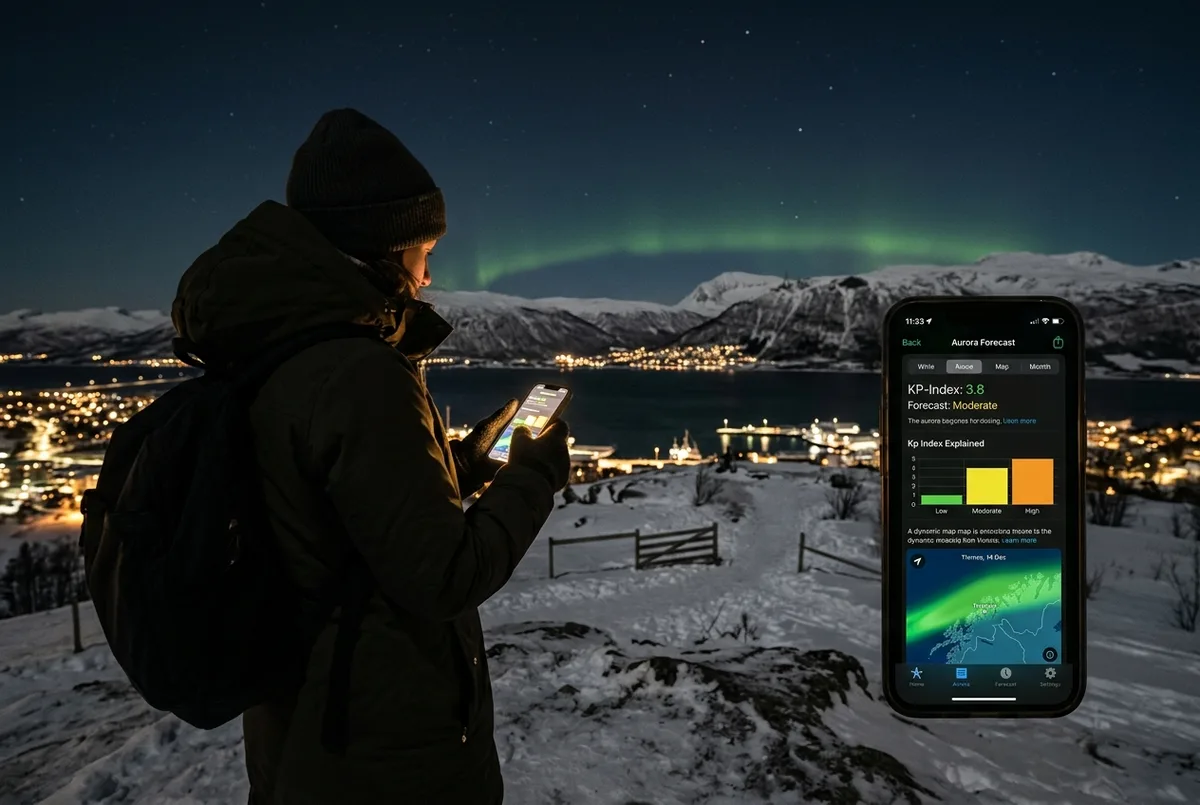
Kp index explained the way a Tromso guide would actually explain it: it is a 0 to 9 scale tracking how disturbed Earth’s magnetic field is at any given moment, and a higher number generally means a stronger, more widespread aurora display reaching further from the poles. Here is what I would actually do with that number: stop treating it as a pass or fail score, since Tromso’s latitude means even a modest reading can produce a genuinely strong show overhead. This guide covers how the scale works, why the current run of solar cycle years favors frequent activity, and which free tools actually give you a reliable read on tonight’s odds. If the underlying science is still fuzzy, my plain-language guide to what causes the northern lights covers the solar wind and magnetosphere basics this page builds on.
What Does the Kp Index Actually Measure?
The Kp index measures global geomagnetic activity on a 0 to 9 scale, derived from magnetometer readings at stations spread around the world, updated roughly every three hours.
I would think of it less as a weather forecast and more as an activity dial for the whole planet’s magnetic field. A Kp of 0 or 1 means things are quiet, a Kp of 4 or 5 is a genuinely active night, and anything above 6 is a rare, strong geomagnetic storm that pushes visible aurora activity much further south than usual.
Why Doesn’t Tromso Need a High Kp Number to See a Strong Display?
Tromso sits almost directly beneath the auroral oval, the ring of peak aurora activity that circles the magnetic pole, so even a low Kp reading of 2 or 3 can still produce a bright, overhead display here.
I would not compare Tromso’s odds to a lower-latitude location that genuinely does need a high Kp number to see anything at all. Guides working this coast every night know a “boring” Kp 2 forecast has produced some of their best evenings, since the number is a global average, not a promise about what a specific spot beneath the oval will actually get.
What’s the Difference Between Kp and Solar Activity in General?
Kp measures the immediate effect on Earth’s magnetic field right now, while broader solar activity, sunspots, flares and coronal mass ejections, describes what the sun itself is doing, which then shapes the Kp readings over the following hours or days.
I would treat solar activity as the weather system and Kp as today’s actual temperature reading. A big solar flare a day or two ago is often the real reason tonight’s Kp forecast looks stronger than usual, so a genuinely engaged guide is watching both the immediate number and the recent solar news feeding into it.
Are We in a Good Part of the Solar Cycle for Aurora Hunting Right Now?
The sun runs on a roughly eleven-year solar cycle, and recent years have trended toward a stronger solar maximum, which generally means more frequent and more intense aurora activity than the quieter years earlier in the cycle.
I would treat this as genuinely good timing rather than a reason to rush unnecessarily. A trip planned around the current solar cycle years should see noticeably more active nights on average than a trip booked during a quiet solar minimum stretch, though I would still never treat any single night as guaranteed regardless of where the broader cycle sits.

Which Aurora Forecast Apps Are Actually Worth Checking?
Free tools like the NOAA Space Weather Prediction Center’s aurora forecast and several dedicated aurora forecast apps pull from the same underlying magnetometer data and give a reasonably reliable short-term Kp and visibility read.
I would use one of these to set expectations before heading out, not as a substitute for an actual guide’s judgment on the night. A guide watching live regional weather cameras alongside the Kp number is doing a more sophisticated version of what any single app promises, since cloud cover, not the Kp reading, is usually what actually decides your night.
Should You Cancel a Tour if the Kp Forecast Looks Low?
No, and I would actively push back on that instinct if a low forecast tempts you to reschedule. Cloud cover on the night matters at least as much as the Kp number, and a clear sky under a modest Kp reading regularly beats a cloudy night under a supposedly stronger forecast.
I would only worry about a genuinely quiet forecast, Kp 0 or 1 with clear sky, as a slightly weaker bet, not a wasted evening. Even then, a guide working the live camera network can often still find a faint but real display somewhere along the route, which is exactly the case for booking a dedicated chase tour instead of relying on a forecast number alone from your hotel room.
Does a High Kp Number Guarantee You’ll See Something Spectacular?
Not necessarily, since a high Kp reading paired with heavy cloud cover still means you see nothing, and geomagnetic storms strong enough to push the number very high are also rare enough that most trips will never encounter one.
I would treat a high Kp forecast as genuinely exciting news but never bank an entire trip on catching one. My guide to whether a northern lights tour is actually worth it covers the realistic odds across an average multi-night trip, rather than the best-case scenario a single high-Kp night represents.
How Should a First-Time Visitor Actually Use This Number?
Check it as one input among several, alongside cloud cover and your guide’s own read on the night, rather than treating it as the single deciding factor for whether to go out at all.
I would rather book a multi-night chase tour that goes out regardless of a modest forecast than skip a night because the number alone looked unremarkable. My guide to what the northern lights actually look like in person covers what to expect at different strength levels, from a faint glow up to a genuinely active night.
My Honest Recommendation
I would stop refreshing a forecast app every hour before your trip and instead trust a guide who is watching live regional cameras and Kp data throughout the actual evening, since that combination beats any single number checked from a hotel room. Book a tour with no fixed distance limit if you can, since the ability to chase toward wherever the sky is genuinely clearest matters more than the forecast you started the night with.
Given how active recent solar cycle years have run, I would go into a Tromso trip with real optimism, book at least three nights if your schedule allows it, and treat the Kp number as one useful piece of context rather than a verdict on your entire trip before it has even started.
Frequently Asked Questions
What is a good Kp index for seeing the northern lights in Tromso?
A Kp of 2 or 3 is often enough given Tromso’s position beneath the auroral oval, though cloud cover on the night matters just as much as the number itself.
Is the Kp index the same as an aurora forecast?
Not quite. Kp measures geomagnetic activity, one key input into a forecast, but cloud cover and your specific location still decide whether you can actually see anything.
Are we currently in a strong part of the solar cycle for aurora activity?
Recent years have trended toward a stronger solar maximum, generally meaning more frequent and intense displays than the quieter years earlier in the roughly eleven-year cycle.
Should I cancel my tour if the Kp forecast looks low the night I’m booked?
No. Clear sky under a modest Kp reading regularly beats a cloudy night under a higher forecast, and a guide chasing live conditions can often still find a real display.
Do free aurora forecast apps give an accurate read?
Reasonably so for the short term, since most pull from the same underlying data, but they cannot account for hyper-local cloud cover the way a guide actively watching the sky can.
Explore Understanding the Aurora
For the technical definition behind this scale, the Wikipedia entry on the K-index covers how magnetometer stations around the world actually calculate it. Whatever tonight’s number reads, I would still get a Tromso Northern Lights tour on the calendar rather than wait for a supposedly perfect forecast that may never arrive.